For years the invisible ingredient in a grease-resistant takeout box was a class of chemicals almost no buyer thought about: PFAS, the so-called forever chemicals that kept oil and moisture from soaking through paper and fiber. That era is ending fast, and it is now a purchasing problem, not just an environmental one. A box that would have been routine two years ago can be illegal to sell in a growing list of states, and the labels that replace PFAS come with their own fine print. This guide walks through what changed, what the alternatives actually are, and how to read a compostable claim before you commit to a print run.
What PFAS did, and why it is being banned
PFAS earned its place in foodservice packaging because it works. A thin fluorochemical treatment gives paper and molded fiber excellent resistance to grease and water, which is exactly what a burger box or a fry sleeve needs. The problem is persistence. These compounds do not meaningfully break down in the environment or the body, they migrate from packaging into food, and they have been linked in the research literature to a range of health concerns. That combination of durability and toxicity is why regulators singled out food packaging first: it is a direct, avoidable exposure route. The practical upshot for a restaurant is that “grease-resistant” can no longer be assumed to be compliant. You now have to know what is creating the barrier.
The bans are already here
This is not a future risk to monitor; it is a present rule in much of the country. A wave of state laws now prohibits the sale or distribution of food packaging with intentionally added PFAS, and the map has filled in quickly over just a few years.
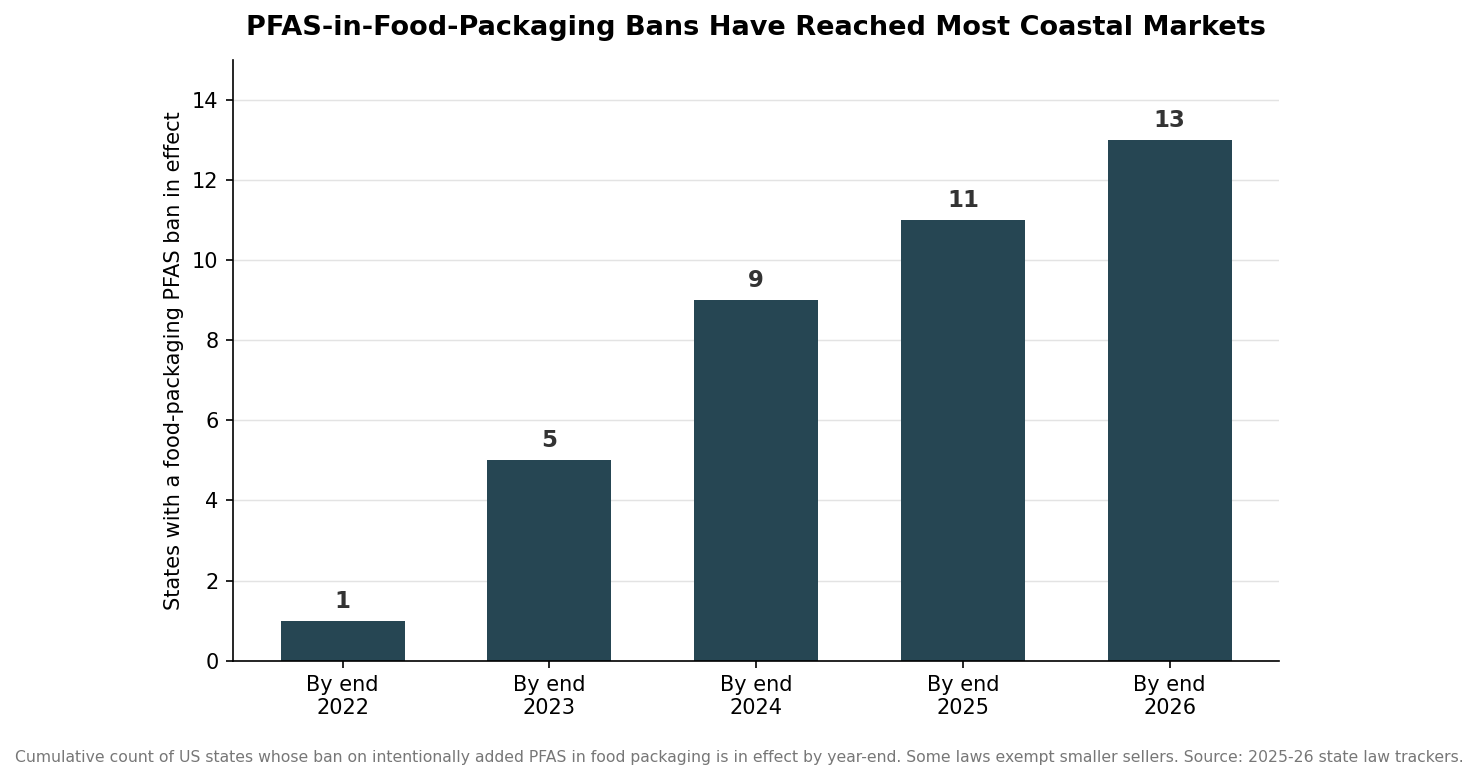
New York and California led, with effective dates around 2022 and 2023, followed by Washington, Vermont, Connecticut, then Colorado, Maryland, Minnesota, and Hawaii, and more recently Oregon and Rhode Island. Illinois and Maine round out the set with 2026 effective dates, Maine’s aimed specifically at plant-fiber packaging such as bags, sleeves, containers, food boats, wraps, and pizza boxes. Details vary in ways that matter: some laws exempt smaller sellers below a revenue threshold, and definitions of “intentionally added” differ. The dependable takeaway is that if you ship or sell in coastal and upper-Midwest markets, PFAS-free is effectively the baseline, and the exact wording of your state’s statute is worth confirming rather than assuming.
What replaces PFAS for grease resistance
The good news is that PFAS-free does not mean grease-through. Several barrier technologies are in commercial use, and they behave differently at the end of life, which is the part buyers most often miss. Water-based, or aqueous, dispersion coatings are sprayed or applied to fiber to create a grease and moisture barrier without fluorochemicals, and they are engineered to keep the box recyclable or repulpable in many cases. Bio-based coatings derived from plant starches or proteins do similar work from renewable inputs. PLA linings, a corn-derived bioplastic film, give a strong barrier and pair naturally with compostable positioning, though PLA-lined fiber is generally meant for industrial composting rather than the recycling stream. Older polyethylene (PE) linings remain PFAS-free and effective but complicate both recycling and composting because the plastic film must be separated. There is also plain mechanical densification, where fiber is compressed for a modest natural barrier with no coating at all.
The point is that the barrier you choose quietly decides your box’s disposal story. An aqueous-coated kraft box can often be recycled; a PLA-lined box usually needs a commercial composter to live up to its label; a PE-lined box tends to end up in landfill. If sustainability messaging is part of your brand, match the coating to the end-of-life claim you actually intend to make.
“Compostable” is a specific claim, not a vibe
Because so many PFAS-free boxes are marketed as compostable, it is worth knowing what that word certifies. In the United States the anchor standard is ASTM D6400, which covers materials designed to break down in aerobic municipal or industrial composting facilities; ASTM D6868 extends similar criteria to coatings and films on paper substrates. The most recognized third-party mark, BPI certification, is built on those standards, and it certifies a finished product or SKU, not a generic material. A common and costly mistake is to treat a certificate for a resin or a base sheet as proof that the finished, printed, coated box is compostable, when inks, adhesives, and coatings all have to fall within scope.
The other distinction that trips people up is industrial versus home composting. A box certified for industrial composting will not necessarily break down in a backyard pile, because commercial facilities reach higher, sustained temperatures. Separate schemes exist for each, and an industrial mark cannot claim home compostability. If your customers do not have access to commercial composting, a compostable box may still end up in the trash, which is worth being honest about in your messaging. Europe’s EN 13432 plays a comparable role abroad if you sell internationally.
How to buy compliant boxes without overpaying
Turning all of this into a clean purchase comes down to sequencing. First, confirm the PFAS rules for every state you sell into, because the deadlines that once looked distant have largely passed.
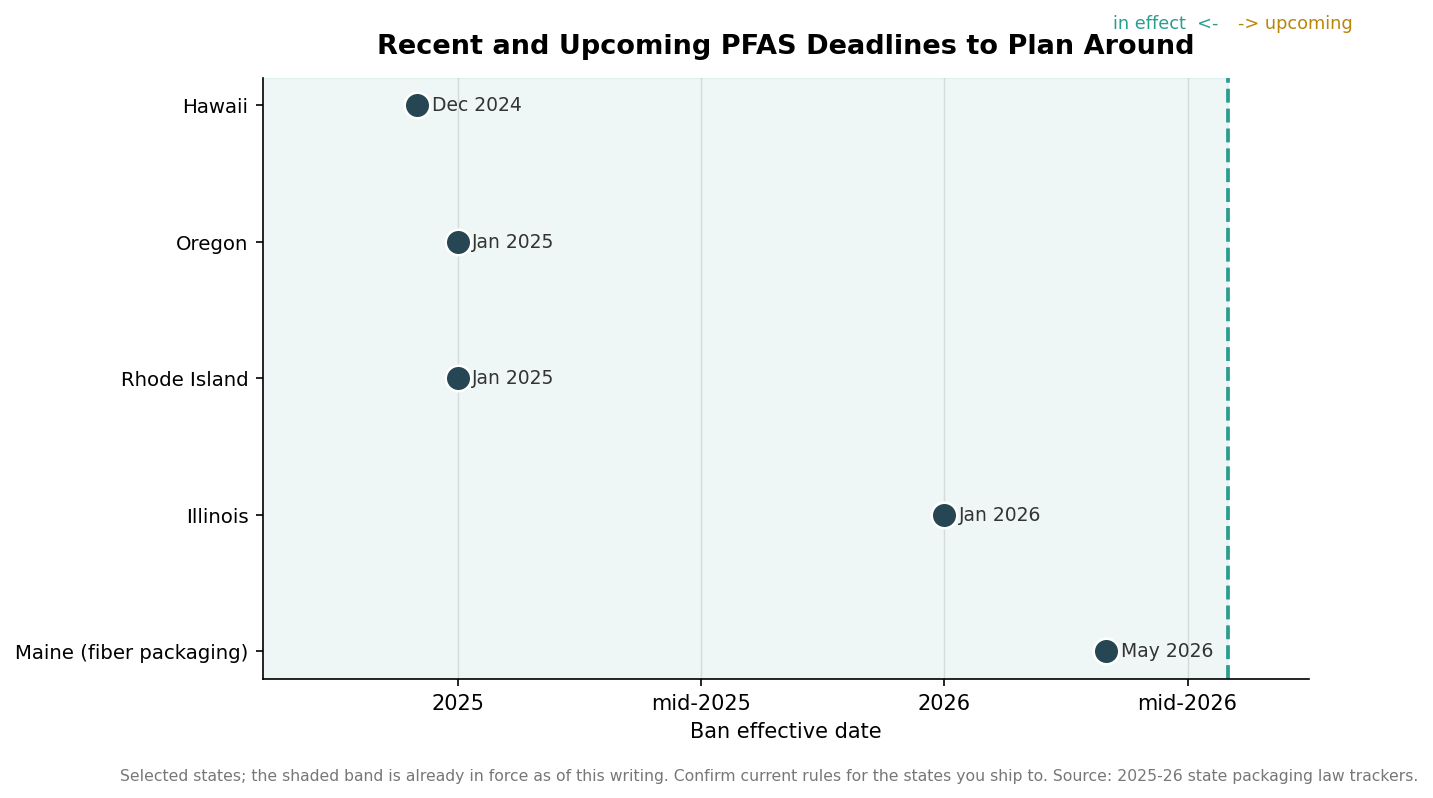
As the timeline shows, the recent and upcoming effective dates are now behind us for most of the states that acted early, which means compliance is expected today rather than something to prepare for later. Second, ask your supplier for documentation specific to the finished box you are ordering: a statement that no PFAS was intentionally added, and, if you are claiming compostability, the BPI or ASTM certification for that SKU rather than for a component. Third, choose the barrier technology to match the disposal story you want to tell, whether that is recyclable aqueous-coated kraft or industrially compostable PLA-lined fiber. Print and branding decisions can proceed normally on top of any of these substrates; the coating and compliance questions are what to settle first. The regulations and effective dates here are summarized from state law trackers and are indicative rather than legal advice, so verify the current rules for your specific markets before you place an order.
Leave a Reply