The difference between takeout that arrives appetizing and takeout that arrives limp is rarely the kitchen. It is the twenty minutes the food spends sealed inside a hot box, and the packaging decisions made long before the order was cooked. If your fries turn to mush or your fried chicken loses its crunch in transit, the container is usually the culprit, and the fix is a matter of choosing the right one for the food. This guide explains what actually goes wrong and how to select packaging that keeps hot food hot without turning it soggy.
The real enemy is trapped steam
Hot food gives off water vapor, and in a sealed container that vapor has nowhere to go. It hits the cooler lid and walls, condenses back into liquid water, and drips onto the food. That is why a crisp coating goes soft: it is not that the food cooled down, it is that it got rained on from the inside. The hotter and more freshly cooked the item, the more vigorously it steams, so a piece of fried chicken boxed straight from the fryer and sealed tight will steam itself soft within minutes. Grease compounds the problem, softening paperboard and pooling under the food, but condensation is the primary mechanism, and understanding that points straight at the solution.
Venting is the single biggest lever
Letting steam escape does more for food quality than any other single choice. Vented containers, whether that means perforations, raised ridges that hold the lid off the food, or simply a box that is not airtight, give water vapor a path out before it can condense. This is the whole reason clamshells for burgers and fried items are designed with small vents or loose closures rather than a tight seal. The trade-off is heat: an open pack loses warmth faster than a sealed one, so venting is not a free lunch. For crisp foods, texture almost always matters more than the last few degrees of heat, so err toward venting. For soups and saucy dishes, where there is no crispness to protect and spillage is the risk, a tight seal wins instead.
A related tactic is to avoid stacking hot items directly on top of each other and to leave a little headroom, because a container packed to the lid traps more moisture against the food and offers no air gap for vapor to disperse into.
Match the material to the food
Every container material sits somewhere on a trade-off between holding heat and letting the pack breathe. Expanded foam insulates extremely well but breathes poorly and is now restricted or banned in many places, which pushes most operators toward paper-based and fiber options. Molded fiber, often made from bagasse, offers a reasonable balance: it insulates moderately and its porous wall lets some moisture pass rather than pooling. Grease-resistant kraft paperboard is a workhorse for dry and semi-dry items and takes branding beautifully. Vented polypropylene is a strong choice for hot, crisp foods because the venting is engineered in. Aluminum-lined board holds heat well for dishes that will be reheated, though it cannot go in a microwave. The chart below places these on the two axes that matter.
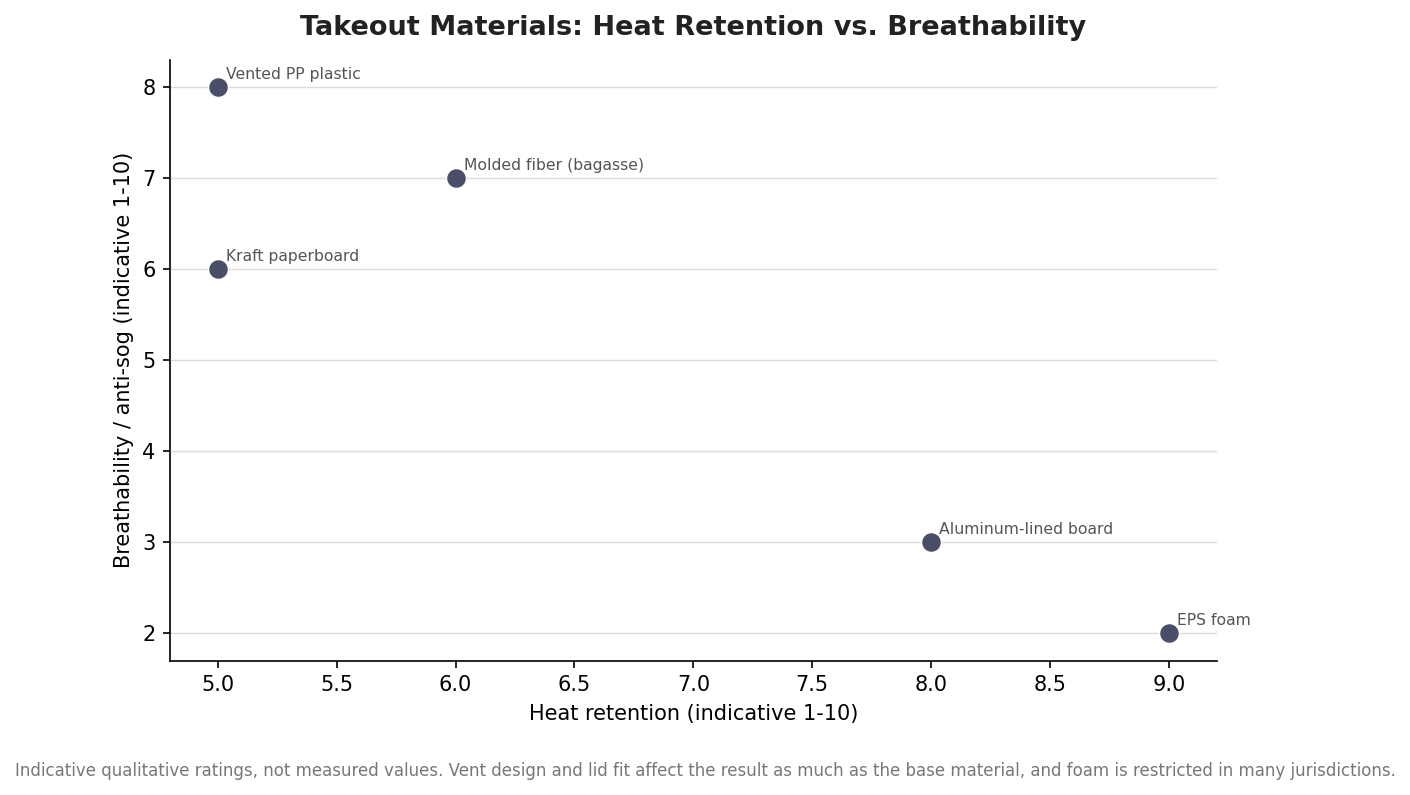
Because no material scores high on both axes, the sensible approach is to stock more than one format and route each dish to the pack that suits it, rather than forcing every order into a single container.
Know how long each food can wait
Different foods tolerate the box for very different lengths of time. A saucy curry or a bowl of rice can sit in a sealed container for the better part of an hour and still eat well, because there is no delicate texture to lose and the moisture is part of the dish. Crisp items are the opposite: fries begin to slump within roughly ten to fifteen minutes of being boxed, and a fried coating is not far behind. The chart below gives indicative windows. These are rough ranges, not guarantees, and they move with starting temperature, portion size, and how well the pack vents, but the ranking is reliable and it should shape both your packaging choice and your delivery routing.
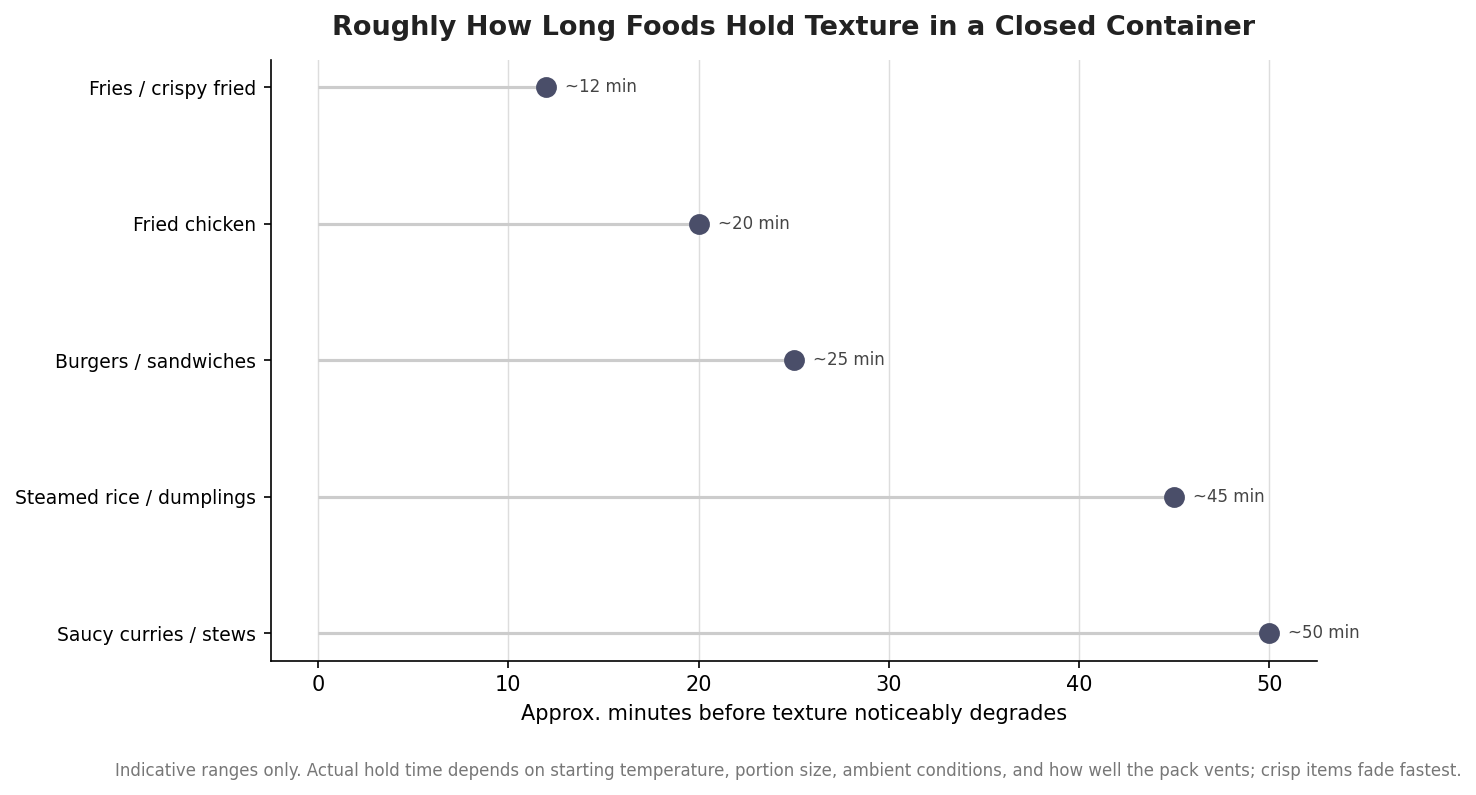
The practical takeaway is to separate wet from dry. Fries packed against a saucy main will steam and wilt regardless of the container, so give crisp sides their own vented compartment or bag and keep sauces in a small closed cup rather than poured over. A well-chosen box cannot rescue a burger that has been sitting under a sauce-soaked bun for half an hour, but the right combination of venting, material, and separation buys you most of the quality that would otherwise be lost between the counter and the customer.
Specifying with all of this in mind
When you order custom takeout packaging, decide the food-to-format mapping first and let it drive the rest. Pick vented formats for anything crisp, reserve tight-sealing containers for liquids, and confirm grease resistance for oily foods so the box holds up and your printed branding does not darken with absorbed oil. Ask a supplier for samples and, ideally, run a real dish through the pack for the actual transit time you expect before committing to a large run. Packaging that looks right on a spec sheet can still disappoint on the doorstep, and the only reliable test is the food itself, boxed the way a customer will receive it.
Leave a Reply