The fastest way to end up with soggy corners, leaks, or a box that swallows a small order is to pick the container by look instead of by the food going in it. Takeout packaging is really a set of specialized tools, and each style is built for a different kind of food. Here is how to match the box to the dish, and what board and printing sit behind each choice.
Start with how the food behaves, not how the box looks
Before comparing shapes, sort your menu by three behaviors: wet, handheld, and delicate. Saucy and wet items such as curries, rice bowls, and noodles need depth, a tight closure, and grease resistance. Handheld items like burgers and sandwiches need a snug footprint that holds shape without crushing. Delicate items such as pastries and layered desserts need a flat, stable floor and a lid that clears the top. A single restaurant usually spans all three, which is why most operations run two or three container styles rather than forcing everything into one.
Oyster pails and food pails: rice, noodles, and saucy mains
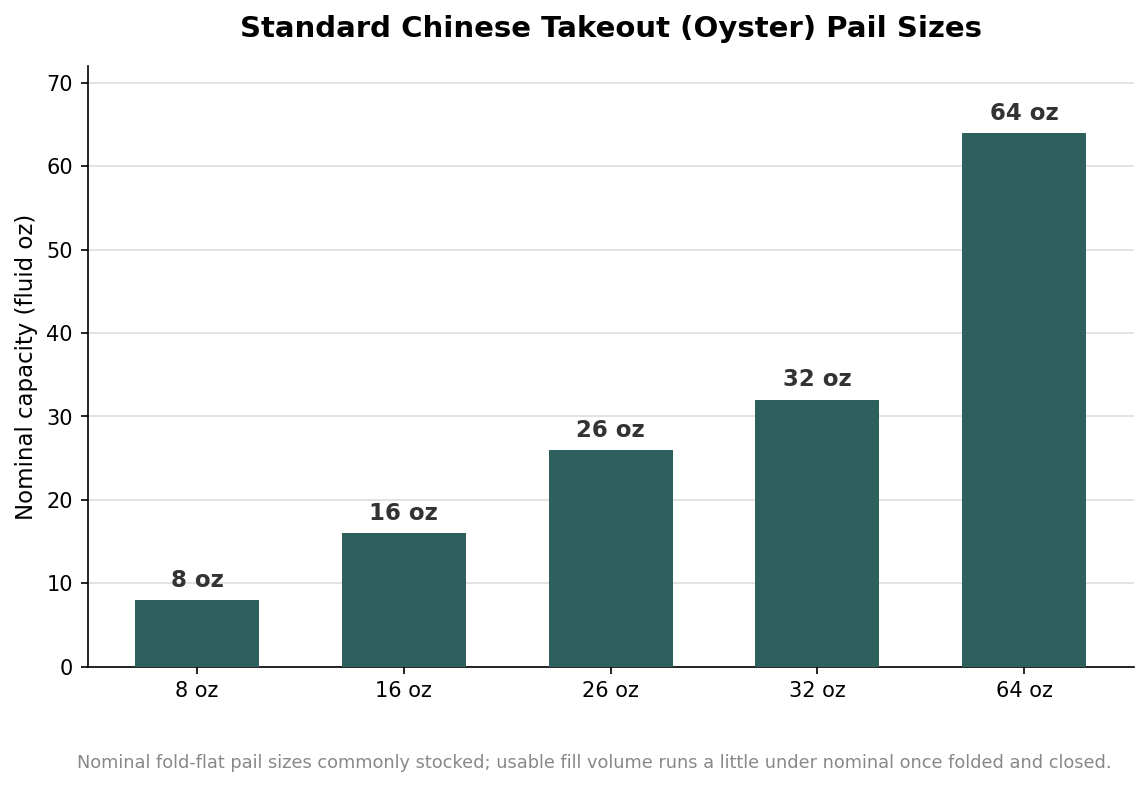
The folded paper pail is the workhorse for wet, scoopable food. Standard Chinese takeout pails come in a tidy ladder of nominal sizes, commonly 8, 16, 26, 32, and 64 ounces, so you can match portion to price without a lot of air in the box. An 8-ounce pail suits a side of rice or a sauce-heavy appetizer, 16 and 26 ounces cover single entrees, and 32 to 64 ounces handle shareable or family portions. Because pails fold flat, they store efficiently and assemble at the counter, and the tapered shape pours cleanly into a bowl at home.
Know the limits. Nominal capacity is measured before folding, so usable fill volume runs a little under the printed number once the box is closed. Pails excel at moist food but are not the right call for anything that needs to breathe: fried items steam and go limp in a sealed pail, so those belong in a vented box instead. If you plan to print a logo, the flat side panels give you a clean canvas, though the fold lines mean you should keep critical artwork away from the creases.
Clamshells and hinged boxes: burgers, sandwiches, and full meals
Hinged clamshells are built for handheld and plated food that has to arrive intact. Common footprints run from about 4 by 4 inches for sliders up to roughly 8 by 5.9 inches for a burger and fries, with 8 by 8 inch and 9 by 9 inch boxes covering full meals. Multi-compartment versions, typically two or three wells in a 9 by 9 inch tray, keep a saucy protein from bleeding into a salad or fries, which is the single most common complaint about single-well boxes. The attached lid means no separate top to lose, and the flat base stacks well for delivery bags.
Material choice matters more here than with pails. Kraft paper and molded-fiber clamshells give a natural, sustainable look and are widely offered with grease-resistant treatment, while corrugated kraft versions add rigidity for heavier plates. If your food is hot and oily, confirm the grease barrier and, per current coating rules, ask specifically for a PFAS-free treatment so the box clears both the venue and the growing list of state bans. Vented clamshells help fried food stay crisp; fully sealed ones trap steam.
Tuck-top cartons, trays, and mailers: bakery, snacks, and meal kits
Flat-walled folding cartons are the branding stars of the lineup. Tuck-top and auto-bottom cartons, sleeves, and mailer-style boxes give you large, uninterrupted print surfaces with no fold lines running through the logo, which makes them the go-to for bakeries, cookie and pastry boxes, snack packs, and retail-style meal kits. A rigid flat floor protects layered or frosted items that a flexible box would smear. Sleeves wrapped around a tray are a low-cost way to brand fries, tacos, or hot dogs while leaving the food visible and vented.
The trade-off is containment. These cartons are engineered for dry, structured, or lightly greasy food, not for anything that pools sauce, so keep soups and saucy mains in a pail or a sealed clamshell. When a carton will see any grease, specify an interior barrier coating rather than assuming plain board will hold. For dry goods the plain board is fine, and it prints beautifully.
The board and print method behind the box
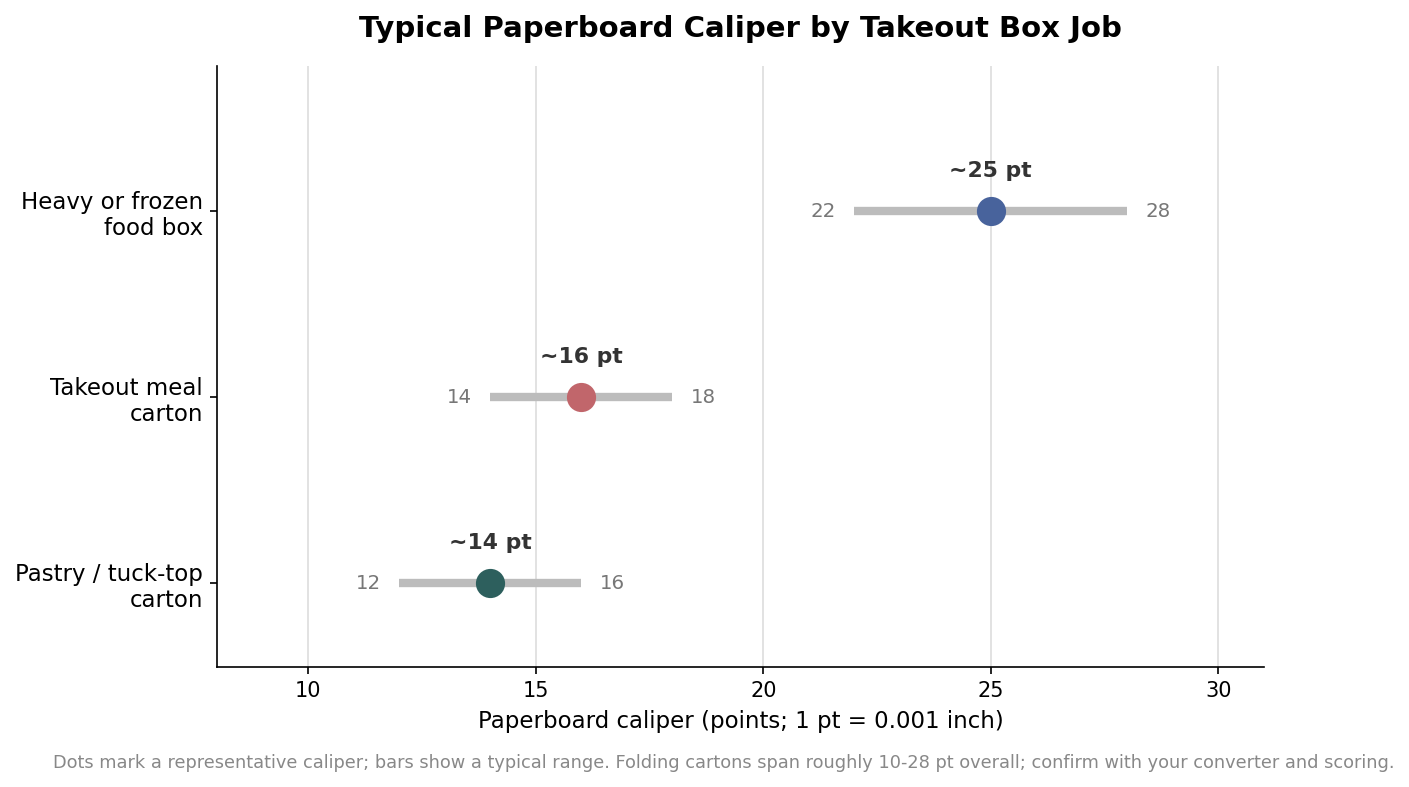
Most food cartons are made from one of three paperboard grades, and the choice drives both durability and print quality. Solid bleached sulfate, or SBS, is bright white, smooth, and the premium choice for direct food contact and sharp graphics. Coated unbleached kraft, or CUK, has a white printable top over a brown back and is the strongest board in the category, with the tear and wet strength that suit heavy or frozen food. Coated recycled board, or CRB, is the economical grey-core option but is best kept to dry goods, since it has lower wet strength and can crack on folds if scoring is off. Caliper, the thickness measured in points where one point equals one-thousandth of an inch, typically lands around 14 to 18 points for everyday takeout cartons and climbs toward 22 to 28 points for heavy-duty boxes, within an overall folding-carton range of roughly 10 to 28 points.
Printing method follows your run size and artwork. Digital printing needs no plates, so it is the practical route for short runs, quick reorders, and full-color photography without a large minimum. Flexographic printing uses reusable plates and becomes economical at high volume, but it is better suited to simple line art and a limited number of spot colors than to fine, complex images. Litho and litho-laminated printing deliver the richest photographic color and support embellishments like foil and embossing, at a higher setup cost that pays off on larger, brand-forward runs. Whichever you choose, start from the printer’s dieline so your artwork, bleed, and fold allowances line up with the actual cut box rather than a flat rectangle.
Sort the menu by wet, handheld, and delicate; give each group the container built for it; then let run size and artwork decide the board and press. Match those three decisions and the food shows up looking the way it left the kitchen.
Leave a Reply