Category: Uncategorized

  • How to Keep Takeout Food Hot and Crisp: A Packaging Selection Guide

    How to Keep Takeout Food Hot and Crisp: A Packaging Selection Guide

    The difference between takeout that arrives appetizing and takeout that arrives limp is rarely the kitchen. It is the twenty minutes the food spends sealed inside a hot box, and the packaging decisions made long before the order was cooked. If your fries turn to mush or your fried chicken loses its crunch in transit, the container is usually the culprit, and the fix is a matter of choosing the right one for the food. This guide explains what actually goes wrong and how to select packaging that keeps hot food hot without turning it soggy.

    The real enemy is trapped steam

    Hot food gives off water vapor, and in a sealed container that vapor has nowhere to go. It hits the cooler lid and walls, condenses back into liquid water, and drips onto the food. That is why a crisp coating goes soft: it is not that the food cooled down, it is that it got rained on from the inside. The hotter and more freshly cooked the item, the more vigorously it steams, so a piece of fried chicken boxed straight from the fryer and sealed tight will steam itself soft within minutes. Grease compounds the problem, softening paperboard and pooling under the food, but condensation is the primary mechanism, and understanding that points straight at the solution.

    Venting is the single biggest lever

    Letting steam escape does more for food quality than any other single choice. Vented containers, whether that means perforations, raised ridges that hold the lid off the food, or simply a box that is not airtight, give water vapor a path out before it can condense. This is the whole reason clamshells for burgers and fried items are designed with small vents or loose closures rather than a tight seal. The trade-off is heat: an open pack loses warmth faster than a sealed one, so venting is not a free lunch. For crisp foods, texture almost always matters more than the last few degrees of heat, so err toward venting. For soups and saucy dishes, where there is no crispness to protect and spillage is the risk, a tight seal wins instead.

    A related tactic is to avoid stacking hot items directly on top of each other and to leave a little headroom, because a container packed to the lid traps more moisture against the food and offers no air gap for vapor to disperse into.

    Match the material to the food

    Every container material sits somewhere on a trade-off between holding heat and letting the pack breathe. Expanded foam insulates extremely well but breathes poorly and is now restricted or banned in many places, which pushes most operators toward paper-based and fiber options. Molded fiber, often made from bagasse, offers a reasonable balance: it insulates moderately and its porous wall lets some moisture pass rather than pooling. Grease-resistant kraft paperboard is a workhorse for dry and semi-dry items and takes branding beautifully. Vented polypropylene is a strong choice for hot, crisp foods because the venting is engineered in. Aluminum-lined board holds heat well for dishes that will be reheated, though it cannot go in a microwave. The chart below places these on the two axes that matter.
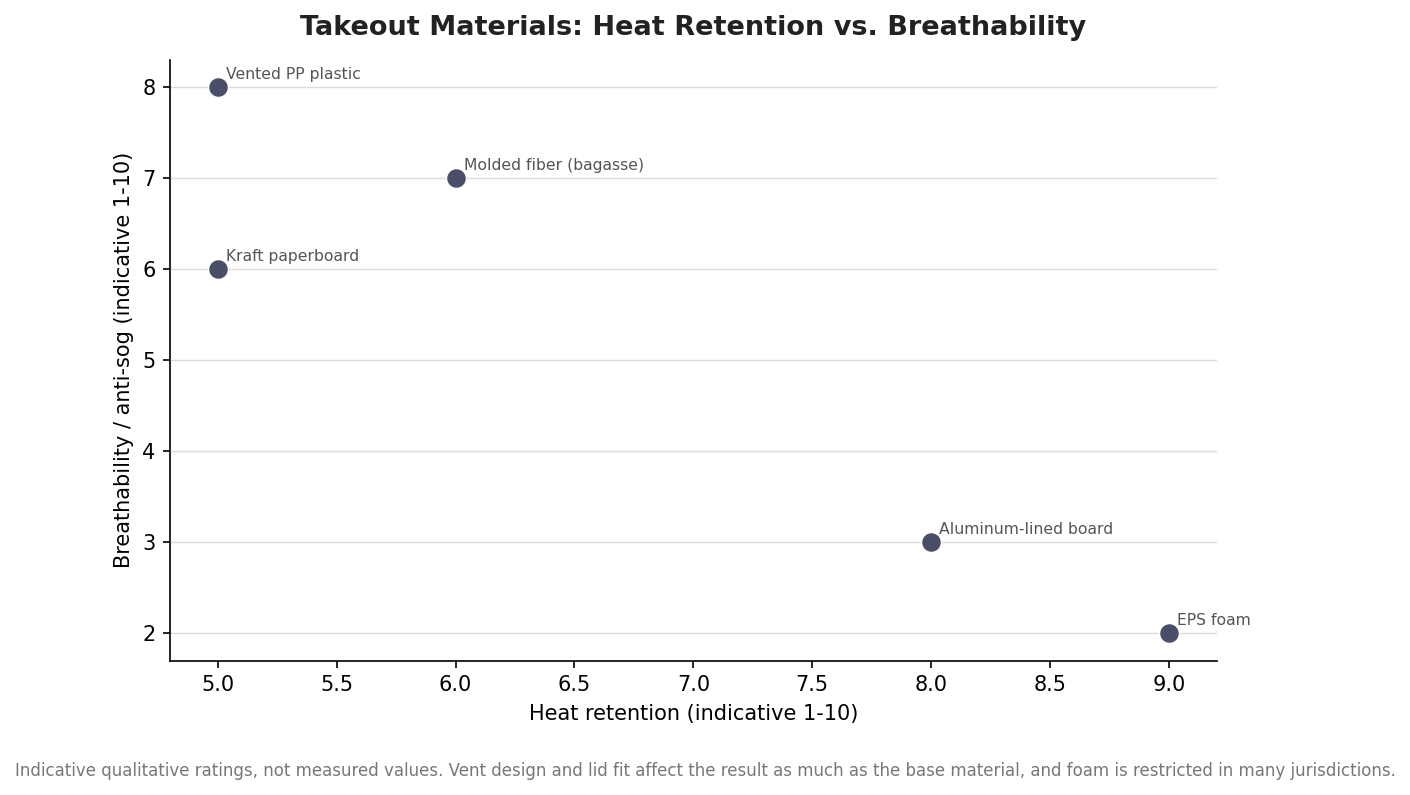
    Scatter plot rating takeout container materials on heat retention versus breathability, from EPS foam to vented PP plastic and molded fiber
    No single material wins both axes, which is why food type should drive the choice.

    Because no material scores high on both axes, the sensible approach is to stock more than one format and route each dish to the pack that suits it, rather than forcing every order into a single container.

    Know how long each food can wait

    Different foods tolerate the box for very different lengths of time. A saucy curry or a bowl of rice can sit in a sealed container for the better part of an hour and still eat well, because there is no delicate texture to lose and the moisture is part of the dish. Crisp items are the opposite: fries begin to slump within roughly ten to fifteen minutes of being boxed, and a fried coating is not far behind. The chart below gives indicative windows. These are rough ranges, not guarantees, and they move with starting temperature, portion size, and how well the pack vents, but the ranking is reliable and it should shape both your packaging choice and your delivery routing.
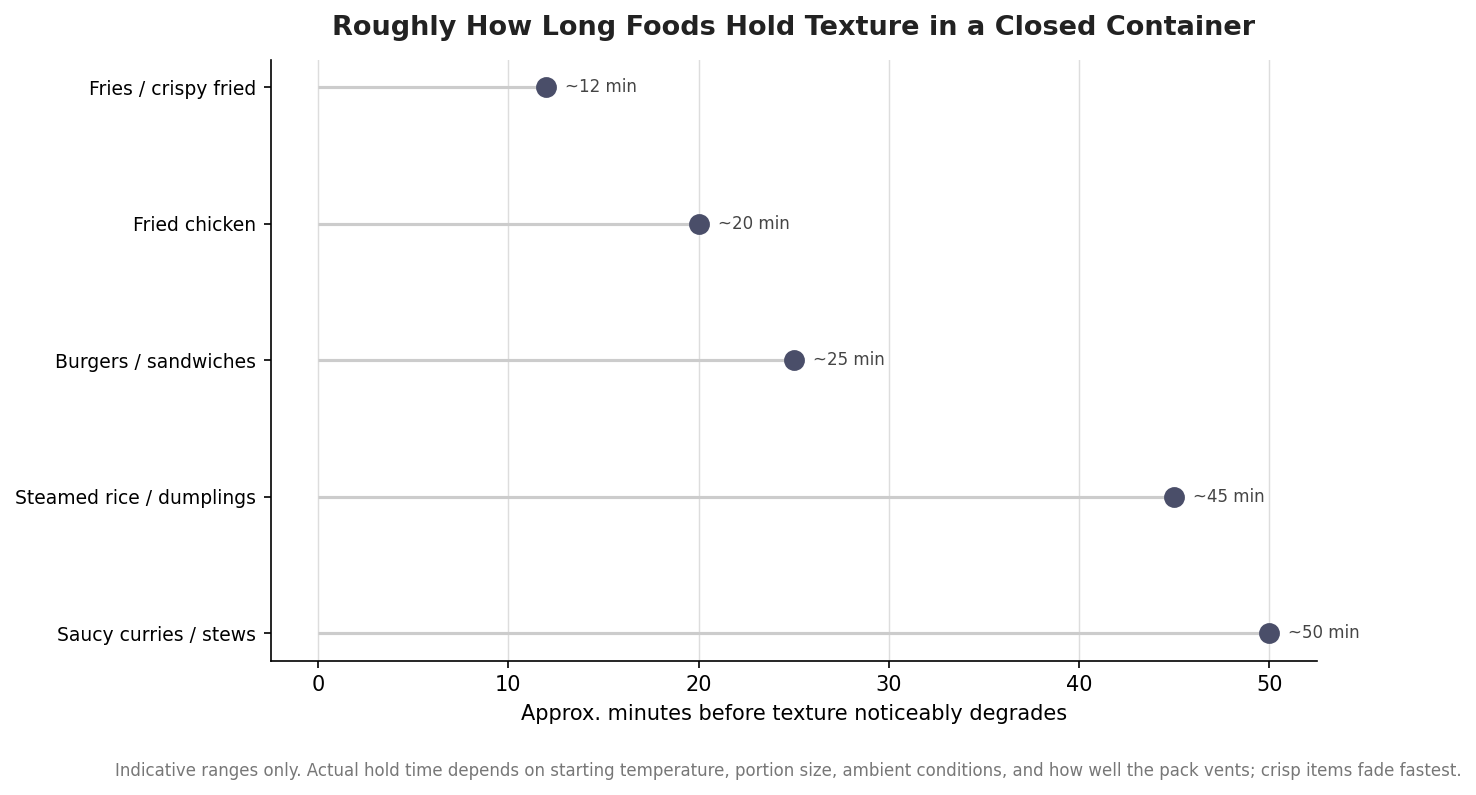
    Dot plot of roughly how long different foods hold texture in a closed container, from about twelve minutes for fries to about fifty for saucy stews
    Crisp foods have the shortest window, so they demand the most venting.

    The practical takeaway is to separate wet from dry. Fries packed against a saucy main will steam and wilt regardless of the container, so give crisp sides their own vented compartment or bag and keep sauces in a small closed cup rather than poured over. A well-chosen box cannot rescue a burger that has been sitting under a sauce-soaked bun for half an hour, but the right combination of venting, material, and separation buys you most of the quality that would otherwise be lost between the counter and the customer.

    Specifying with all of this in mind

    When you order custom takeout packaging, decide the food-to-format mapping first and let it drive the rest. Pick vented formats for anything crisp, reserve tight-sealing containers for liquids, and confirm grease resistance for oily foods so the box holds up and your printed branding does not darken with absorbed oil. Ask a supplier for samples and, ideally, run a real dish through the pack for the actual transit time you expect before committing to a large run. Packaging that looks right on a spec sheet can still disappoint on the doorstep, and the only reliable test is the food itself, boxed the way a customer will receive it.
  • Which Takeout Box Fits Which Food: A Style-by-Style Guide

    Which Takeout Box Fits Which Food: A Style-by-Style Guide

    The fastest way to end up with soggy corners, leaks, or a box that swallows a small order is to pick the container by look instead of by the food going in it. Takeout packaging is really a set of specialized tools, and each style is built for a different kind of food. Here is how to match the box to the dish, and what board and printing sit behind each choice.

    Start with how the food behaves, not how the box looks

    Before comparing shapes, sort your menu by three behaviors: wet, handheld, and delicate. Saucy and wet items such as curries, rice bowls, and noodles need depth, a tight closure, and grease resistance. Handheld items like burgers and sandwiches need a snug footprint that holds shape without crushing. Delicate items such as pastries and layered desserts need a flat, stable floor and a lid that clears the top. A single restaurant usually spans all three, which is why most operations run two or three container styles rather than forcing everything into one.

    Oyster pails and food pails: rice, noodles, and saucy mains

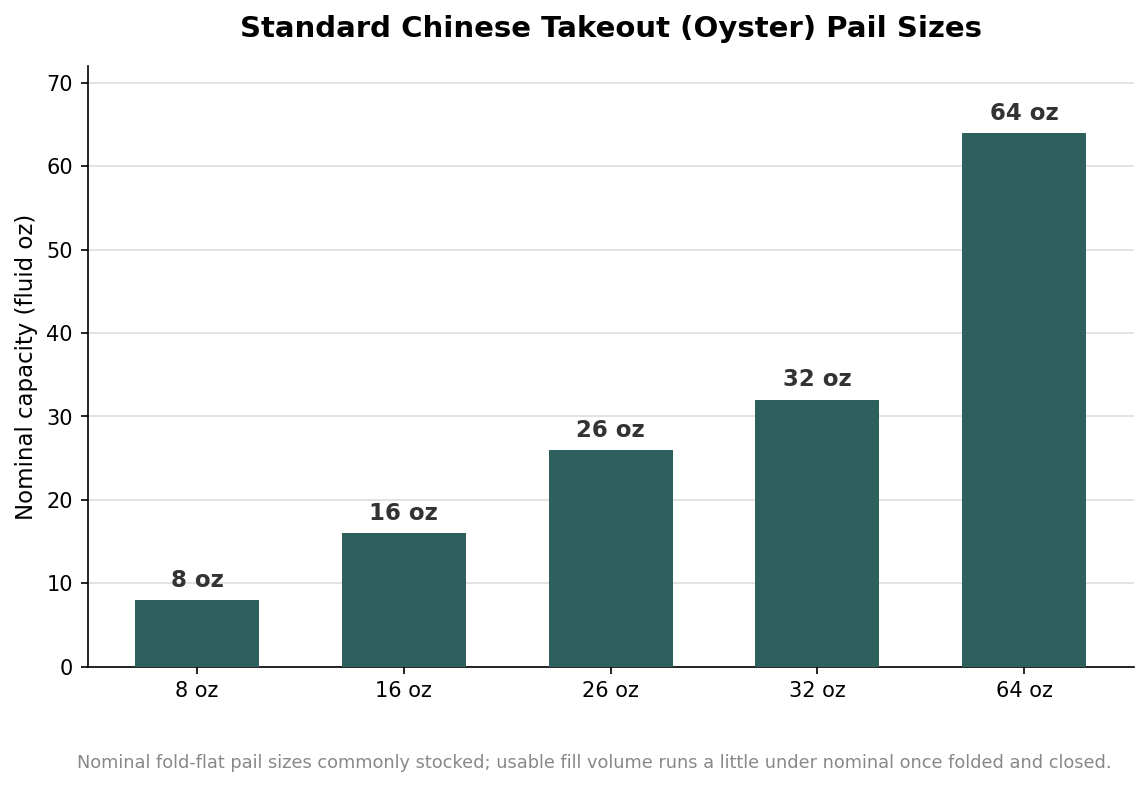
    The folded paper pail is the workhorse for wet, scoopable food. Standard Chinese takeout pails come in a tidy ladder of nominal sizes, commonly 8, 16, 26, 32, and 64 ounces, so you can match portion to price without a lot of air in the box. An 8-ounce pail suits a side of rice or a sauce-heavy appetizer, 16 and 26 ounces cover single entrees, and 32 to 64 ounces handle shareable or family portions. Because pails fold flat, they store efficiently and assemble at the counter, and the tapered shape pours cleanly into a bowl at home.

    Know the limits. Nominal capacity is measured before folding, so usable fill volume runs a little under the printed number once the box is closed. Pails excel at moist food but are not the right call for anything that needs to breathe: fried items steam and go limp in a sealed pail, so those belong in a vented box instead. If you plan to print a logo, the flat side panels give you a clean canvas, though the fold lines mean you should keep critical artwork away from the creases.

    Bar chart of standard Chinese takeout oyster pail sizes at 8, 16, 26, 32 and 64 fluid ounces
    The standard oyster-pail size ladder, from an 8 oz side to a 64 oz shareable portion.

    Clamshells and hinged boxes: burgers, sandwiches, and full meals

    Hinged clamshells are built for handheld and plated food that has to arrive intact. Common footprints run from about 4 by 4 inches for sliders up to roughly 8 by 5.9 inches for a burger and fries, with 8 by 8 inch and 9 by 9 inch boxes covering full meals. Multi-compartment versions, typically two or three wells in a 9 by 9 inch tray, keep a saucy protein from bleeding into a salad or fries, which is the single most common complaint about single-well boxes. The attached lid means no separate top to lose, and the flat base stacks well for delivery bags.

    Material choice matters more here than with pails. Kraft paper and molded-fiber clamshells give a natural, sustainable look and are widely offered with grease-resistant treatment, while corrugated kraft versions add rigidity for heavier plates. If your food is hot and oily, confirm the grease barrier and, per current coating rules, ask specifically for a PFAS-free treatment so the box clears both the venue and the growing list of state bans. Vented clamshells help fried food stay crisp; fully sealed ones trap steam.

    Tuck-top cartons, trays, and mailers: bakery, snacks, and meal kits

    Flat-walled folding cartons are the branding stars of the lineup. Tuck-top and auto-bottom cartons, sleeves, and mailer-style boxes give you large, uninterrupted print surfaces with no fold lines running through the logo, which makes them the go-to for bakeries, cookie and pastry boxes, snack packs, and retail-style meal kits. A rigid flat floor protects layered or frosted items that a flexible box would smear. Sleeves wrapped around a tray are a low-cost way to brand fries, tacos, or hot dogs while leaving the food visible and vented.

    The trade-off is containment. These cartons are engineered for dry, structured, or lightly greasy food, not for anything that pools sauce, so keep soups and saucy mains in a pail or a sealed clamshell. When a carton will see any grease, specify an interior barrier coating rather than assuming plain board will hold. For dry goods the plain board is fine, and it prints beautifully.

    The board and print method behind the box

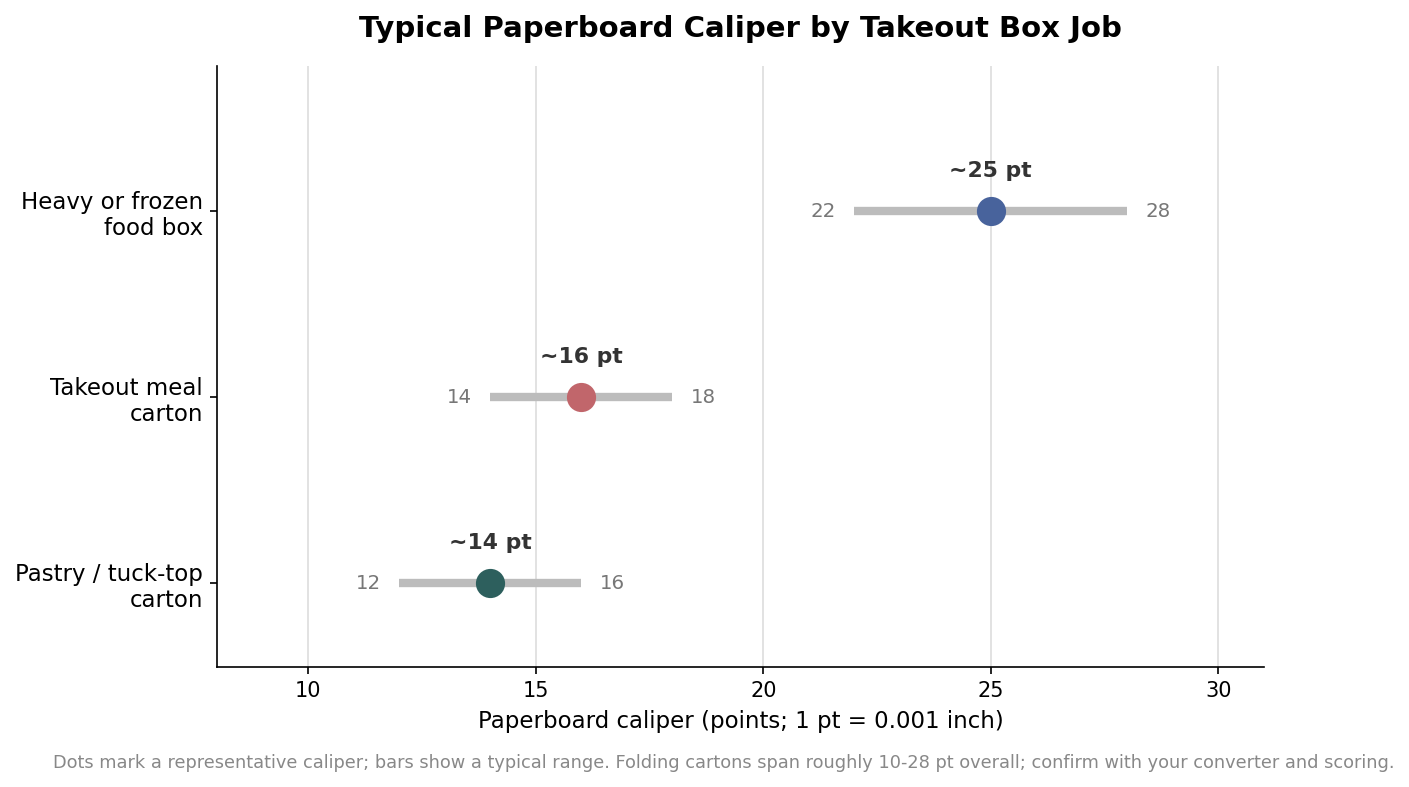
    Most food cartons are made from one of three paperboard grades, and the choice drives both durability and print quality. Solid bleached sulfate, or SBS, is bright white, smooth, and the premium choice for direct food contact and sharp graphics. Coated unbleached kraft, or CUK, has a white printable top over a brown back and is the strongest board in the category, with the tear and wet strength that suit heavy or frozen food. Coated recycled board, or CRB, is the economical grey-core option but is best kept to dry goods, since it has lower wet strength and can crack on folds if scoring is off. Caliper, the thickness measured in points where one point equals one-thousandth of an inch, typically lands around 14 to 18 points for everyday takeout cartons and climbs toward 22 to 28 points for heavy-duty boxes, within an overall folding-carton range of roughly 10 to 28 points.

    Dot plot of typical paperboard caliper: about 14 points for pastry cartons, 16 for takeout meal cartons, and 25 for heavy or frozen food boxes
    Representative paperboard caliper by box job, with typical ranges; one point equals one-thousandth of an inch.

    Printing method follows your run size and artwork. Digital printing needs no plates, so it is the practical route for short runs, quick reorders, and full-color photography without a large minimum. Flexographic printing uses reusable plates and becomes economical at high volume, but it is better suited to simple line art and a limited number of spot colors than to fine, complex images. Litho and litho-laminated printing deliver the richest photographic color and support embellishments like foil and embossing, at a higher setup cost that pays off on larger, brand-forward runs. Whichever you choose, start from the printer’s dieline so your artwork, bleed, and fold allowances line up with the actual cut box rather than a flat rectangle.

    Sort the menu by wet, handheld, and delicate; give each group the container built for it; then let run size and artwork decide the board and press. Match those three decisions and the food shows up looking the way it left the kitchen.

  • PFAS, Grease Resistance, and Compostable Claims: A Compliance Guide to Takeout Box Coatings

    PFAS, Grease Resistance, and Compostable Claims: A Compliance Guide to Takeout Box Coatings

    For years the invisible ingredient in a grease-resistant takeout box was a class of chemicals almost no buyer thought about: PFAS, the so-called forever chemicals that kept oil and moisture from soaking through paper and fiber. That era is ending fast, and it is now a purchasing problem, not just an environmental one. A box that would have been routine two years ago can be illegal to sell in a growing list of states, and the labels that replace PFAS come with their own fine print. This guide walks through what changed, what the alternatives actually are, and how to read a compostable claim before you commit to a print run.

    What PFAS did, and why it is being banned

    PFAS earned its place in foodservice packaging because it works. A thin fluorochemical treatment gives paper and molded fiber excellent resistance to grease and water, which is exactly what a burger box or a fry sleeve needs. The problem is persistence. These compounds do not meaningfully break down in the environment or the body, they migrate from packaging into food, and they have been linked in the research literature to a range of health concerns. That combination of durability and toxicity is why regulators singled out food packaging first: it is a direct, avoidable exposure route. The practical upshot for a restaurant is that “grease-resistant” can no longer be assumed to be compliant. You now have to know what is creating the barrier.

    The bans are already here

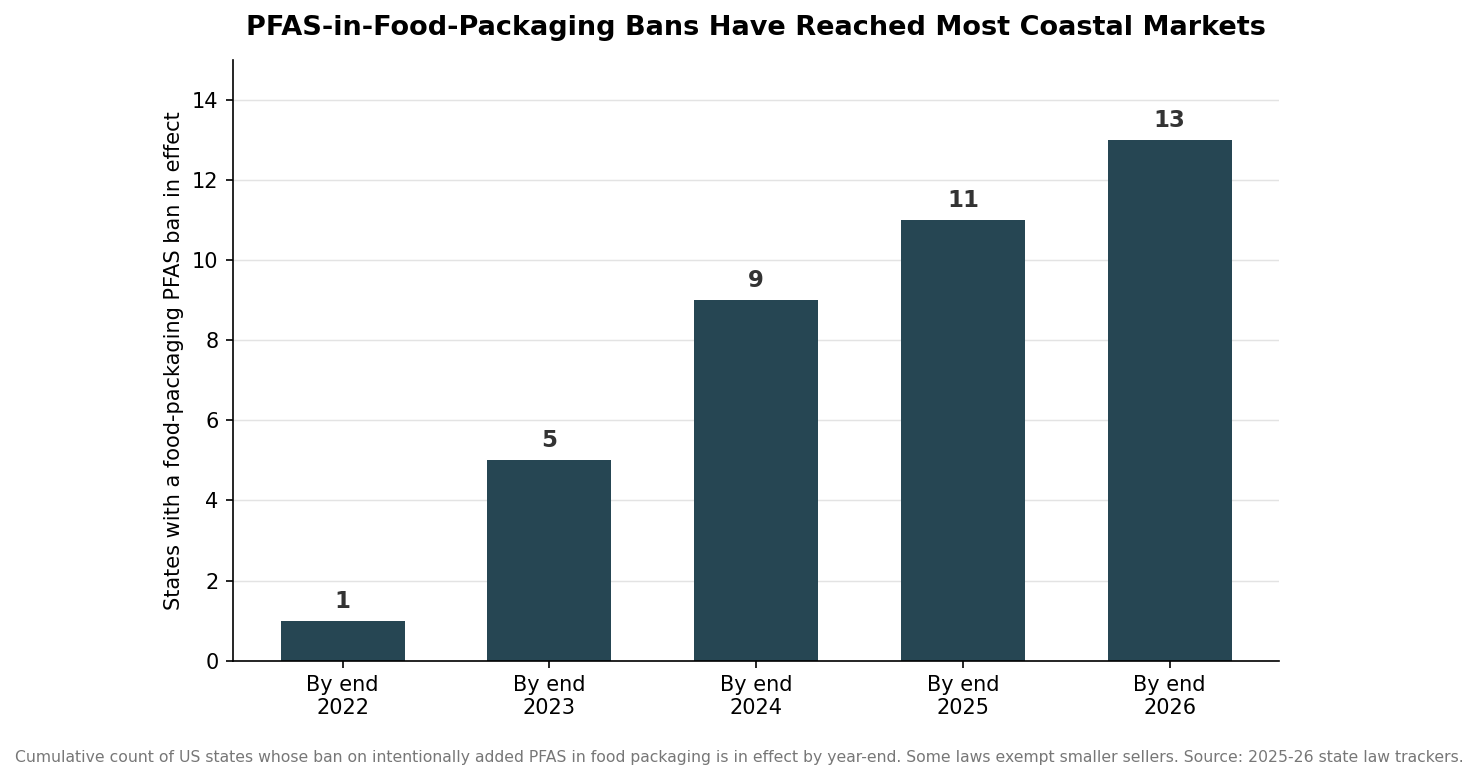
    This is not a future risk to monitor; it is a present rule in much of the country. A wave of state laws now prohibits the sale or distribution of food packaging with intentionally added PFAS, and the map has filled in quickly over just a few years.

    Bar chart of the cumulative number of US states with a food-packaging PFAS ban in effect by year from 2022 to 2026
    The number of states banning intentionally added PFAS in food packaging has climbed from one to more than a dozen.

    New York and California led, with effective dates around 2022 and 2023, followed by Washington, Vermont, Connecticut, then Colorado, Maryland, Minnesota, and Hawaii, and more recently Oregon and Rhode Island. Illinois and Maine round out the set with 2026 effective dates, Maine’s aimed specifically at plant-fiber packaging such as bags, sleeves, containers, food boats, wraps, and pizza boxes. Details vary in ways that matter: some laws exempt smaller sellers below a revenue threshold, and definitions of “intentionally added” differ. The dependable takeaway is that if you ship or sell in coastal and upper-Midwest markets, PFAS-free is effectively the baseline, and the exact wording of your state’s statute is worth confirming rather than assuming.

    What replaces PFAS for grease resistance

    The good news is that PFAS-free does not mean grease-through. Several barrier technologies are in commercial use, and they behave differently at the end of life, which is the part buyers most often miss. Water-based, or aqueous, dispersion coatings are sprayed or applied to fiber to create a grease and moisture barrier without fluorochemicals, and they are engineered to keep the box recyclable or repulpable in many cases. Bio-based coatings derived from plant starches or proteins do similar work from renewable inputs. PLA linings, a corn-derived bioplastic film, give a strong barrier and pair naturally with compostable positioning, though PLA-lined fiber is generally meant for industrial composting rather than the recycling stream. Older polyethylene (PE) linings remain PFAS-free and effective but complicate both recycling and composting because the plastic film must be separated. There is also plain mechanical densification, where fiber is compressed for a modest natural barrier with no coating at all.

    The point is that the barrier you choose quietly decides your box’s disposal story. An aqueous-coated kraft box can often be recycled; a PLA-lined box usually needs a commercial composter to live up to its label; a PE-lined box tends to end up in landfill. If sustainability messaging is part of your brand, match the coating to the end-of-life claim you actually intend to make.

    “Compostable” is a specific claim, not a vibe

    Because so many PFAS-free boxes are marketed as compostable, it is worth knowing what that word certifies. In the United States the anchor standard is ASTM D6400, which covers materials designed to break down in aerobic municipal or industrial composting facilities; ASTM D6868 extends similar criteria to coatings and films on paper substrates. The most recognized third-party mark, BPI certification, is built on those standards, and it certifies a finished product or SKU, not a generic material. A common and costly mistake is to treat a certificate for a resin or a base sheet as proof that the finished, printed, coated box is compostable, when inks, adhesives, and coatings all have to fall within scope.

    The other distinction that trips people up is industrial versus home composting. A box certified for industrial composting will not necessarily break down in a backyard pile, because commercial facilities reach higher, sustained temperatures. Separate schemes exist for each, and an industrial mark cannot claim home compostability. If your customers do not have access to commercial composting, a compostable box may still end up in the trash, which is worth being honest about in your messaging. Europe’s EN 13432 plays a comparable role abroad if you sell internationally.

    How to buy compliant boxes without overpaying

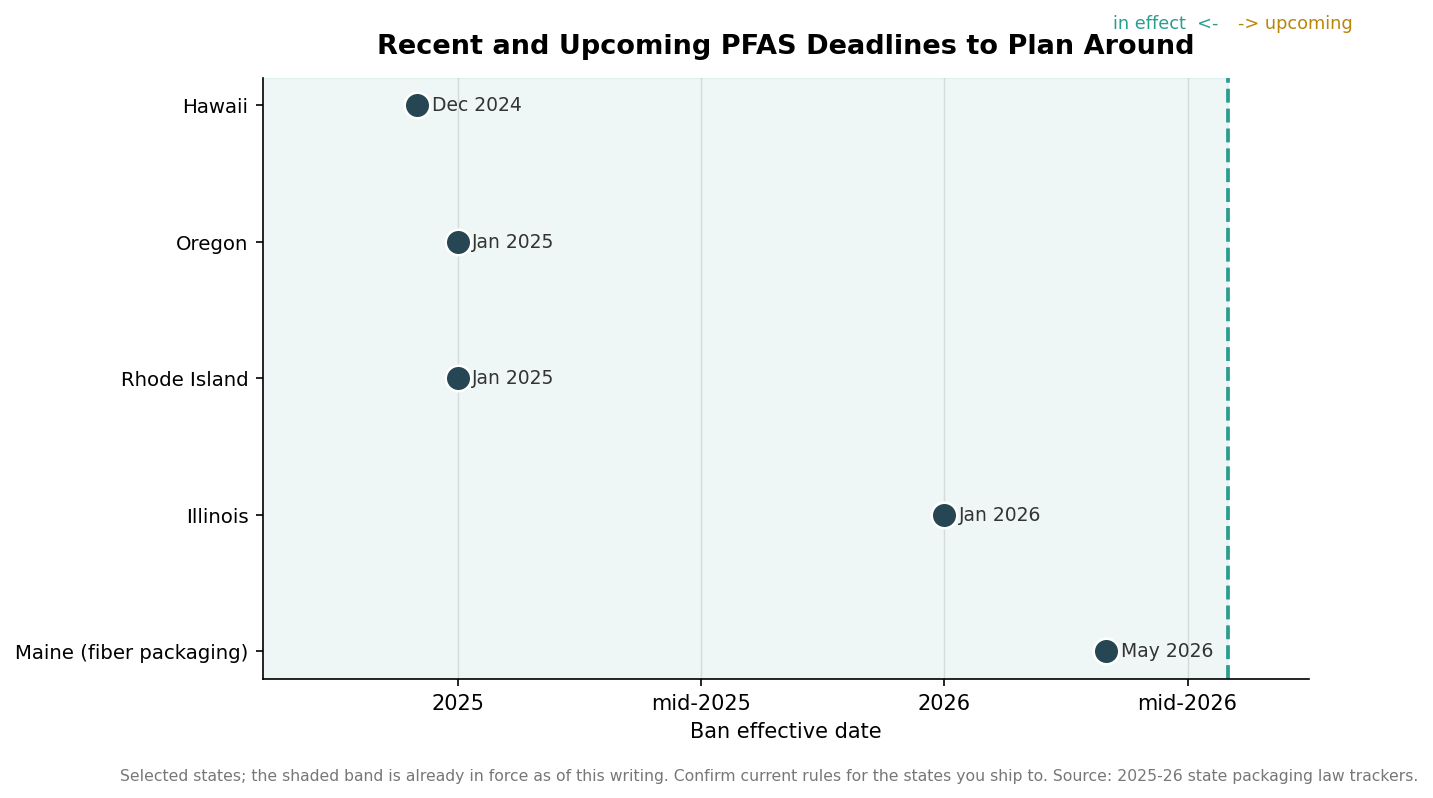
    Turning all of this into a clean purchase comes down to sequencing. First, confirm the PFAS rules for every state you sell into, because the deadlines that once looked distant have largely passed.

    Timeline dot plot of recent and upcoming PFAS food-packaging ban effective dates for Hawaii, Oregon, Rhode Island, Illinois, and Maine
    Effective dates for these states have largely passed, so PFAS-free compliance is expected now, not later.

    As the timeline shows, the recent and upcoming effective dates are now behind us for most of the states that acted early, which means compliance is expected today rather than something to prepare for later. Second, ask your supplier for documentation specific to the finished box you are ordering: a statement that no PFAS was intentionally added, and, if you are claiming compostability, the BPI or ASTM certification for that SKU rather than for a component. Third, choose the barrier technology to match the disposal story you want to tell, whether that is recyclable aqueous-coated kraft or industrially compostable PLA-lined fiber. Print and branding decisions can proceed normally on top of any of these substrates; the coating and compliance questions are what to settle first. The regulations and effective dates here are summarized from state law trackers and are indicative rather than legal advice, so verify the current rules for your specific markets before you place an order.

  • Can You Microwave Takeout Containers? A Material-by-Material Safety Guide

    Can You Microwave Takeout Containers? A Material-by-Material Safety Guide

    The short answer is that it depends entirely on the material, and a few common takeout containers are genuinely unsafe to put in a microwave. A polypropylene deli tub reheats your leftovers without complaint; a foam clamshell can soften and shed chemicals into your food; the wire handle on a Chinese takeout box can start a fire in a couple of minutes. Because the container rarely tells you plainly which it is, here is how to read each type before you press start.

    Plastic containers: read the number on the bottom

    Every plastic container carries a resin identification code, the number from 1 to 7 inside the little triangle on the base, and for microwaving it tells you most of what you need to know. Code 5, polypropylene (PP), is the microwave-safe workhorse of foodservice. It is heat-resistant to roughly 250°F, BPA-free, and the standard material for reusable-style takeout tubs and their lids. A mineral-filled version, MFPP, pushes heat resistance further and is typically rated for reheating in bursts under two minutes.

    The ones to avoid are easy to remember. Code 1 (PET), the clear, thin, glossy plastic used for cold deli and salad containers, is single-use and not made for reheating; it can warp and is not intended to hold hot food. Code 3 (PVC) can release unwanted chemicals under heat. Code 6, polystyrene, which includes foam clamshells and rigid clear cutlery-style plastic, should never be microwaved. Look for the microwave-safe symbol, usually three wavy lines and sometimes a small dish icon, or the words printed on the base. Keep in mind that this mark is assigned by the manufacturer rather than independently certified, so it is a claim of suitability, not a guarantee for indefinite heating.

    Paper and kraft boxes: the lining decides

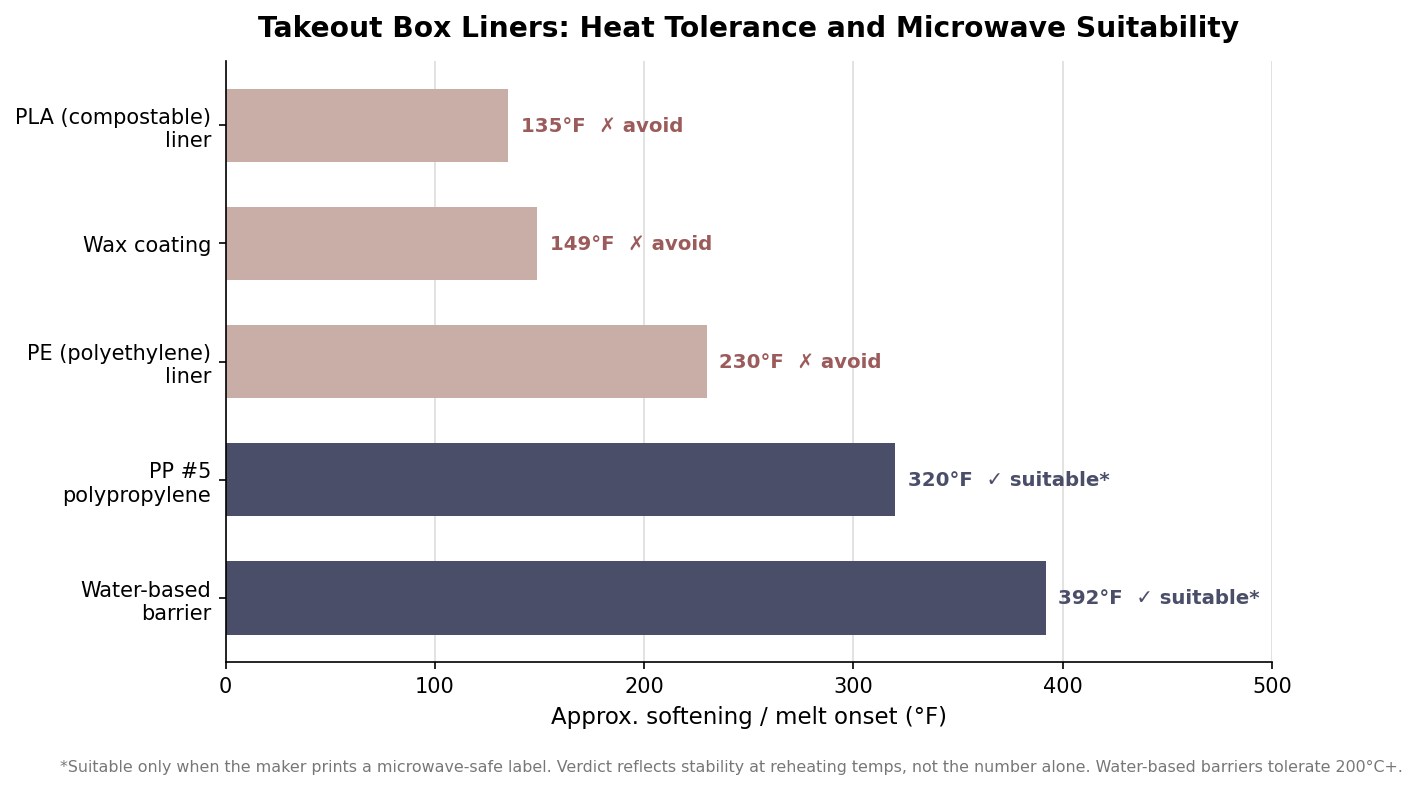
    A plain paperboard box looks harmless, but almost none are bare paper. Nearly all have a thin barrier coating on the inside to hold grease and moisture, and that coating, not the paper, sets the heat limit. The differences are large. A PLA (plant-based, compostable) lining deforms at just 131 to 140°F, well below the temperature of reheated food, which is exactly why “compostable” and “microwave-safe” are not the same thing. A wax coating melts around 140 to 158°F. A polyethylene (PE) lining, the slick plastic feel inside many hot-food boxes, softens at about 221 to 239°F. A polypropylene lining holds up to roughly 320°F, and a newer water-based barrier coating can tolerate 200°C and above, which is why those two are the ones actually suited to reheating when the box is labeled for it.

    Bare uncoated paper can scorch or ignite if it runs dry and overheats, so even a lining-free box is not a license to run the microwave for several minutes. Match the box to the job: if you expect food to be reheated in the container, it needs a PP or water-based barrier and a clear label, not a wax or PLA liner.

    Horizontal bar chart of takeout box liner heat tolerance in Fahrenheit with microwave-safe verdicts
    The lining, not the paper, sets a box’s heat limit; PLA and wax fail well below reheating temperatures.

    Foam, foil, and the classic Chinese takeout box

    Three containers deserve their own warning. Foam (expanded polystyrene) should stay out of the microwave entirely. It softens and deforms under heat and can release styrene into food, and it is now banned or restricted in a growing number of US states for foodservice use. Aluminum and foil containers are metal, so they can arc and spark against the microwave walls; unless your appliance is specifically documented to allow metal, keep them out.

    The folded Chinese takeout box, the oyster pail, is the sneakiest of all because the paperboard body seems microwavable while the thin wire handle is the hazard. Metal handles spark, and dry paper can reach its autoignition point near 451°F, which is why an empty or nearly empty box in a 1,000-watt microwave can catch in as little as two to three minutes. If you must reheat from an oyster pail, remove the metal handle first, or better, tip the food onto a plate. Many of these boxes also have a wax or PE liner that will not survive reheating anyway.

    How to reheat safely when the label is missing

    When you cannot confirm a container is microwave-safe, the safest move is simple: transfer the food to a glass or ceramic dish and reheat that instead. Glass and stoneware handle microwave heat without leaching or warping and cost nothing but a few seconds. When you do reheat in a labeled container, heat in 30 to 60-second intervals rather than one long run, use about 50 percent power to avoid hot spots, and stop well short of two continuous minutes. Vent or remove the lid so steam does not build up, and take plastic lids off entirely, since many are a thinner, less heat-stable plastic than the base. Fatty and sugary foods get much hotter than the container around them, so those in particular are worth moving to glass.

    What this means if you package food for customers

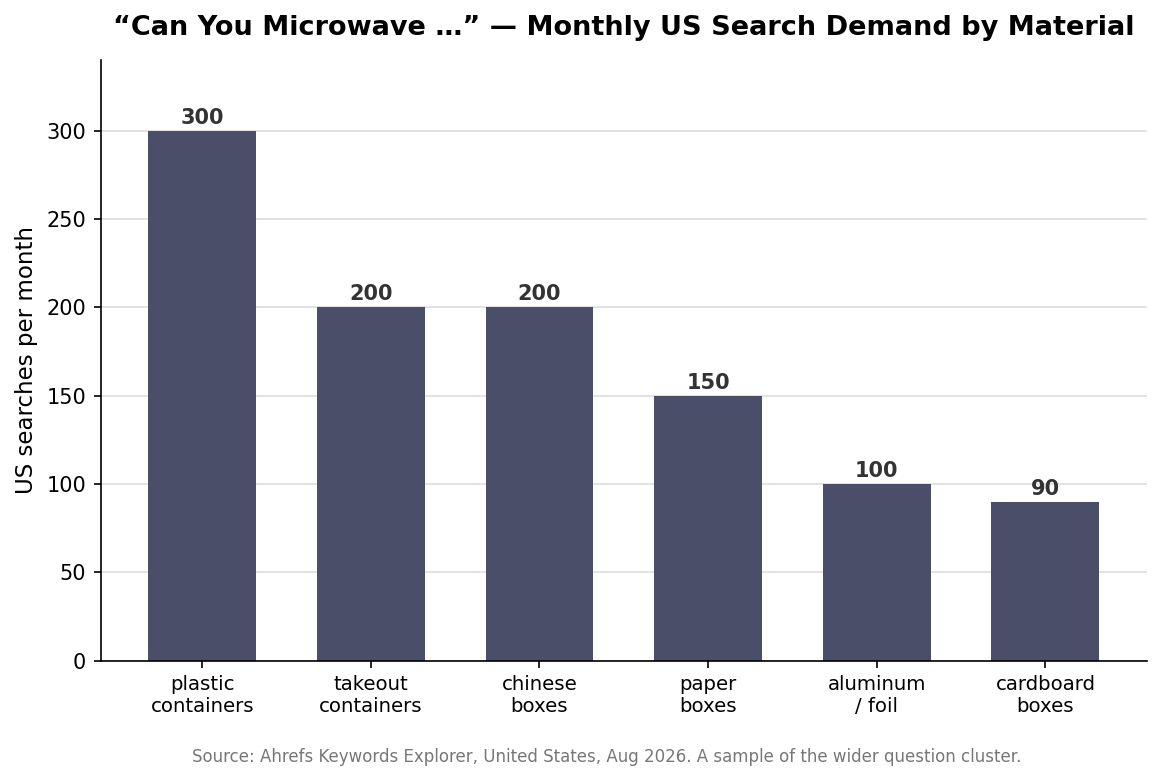
    For a restaurant, food truck, or caterer, the practical decision is whether you want customers to be able to reheat straight from the container. If yes, specify code 5 polypropylene tubs or paperboard with a PP or water-based barrier, and print a short “microwave-safe, lid off, 90 seconds” style instruction where diners will see it. If your packaging is foam, PLA-lined, or wax-coated, it is fine for carrying food but should not carry a microwave claim, and it is worth telling customers to transfer before reheating. Getting this right avoids both melted containers and the more serious complaint of chemicals or fire, and it is a genuinely common customer question, as the search demand below shows.

    Bar chart of monthly US search volume for can-you-microwave questions by container material
    Whether takeout containers can be microwaved is one of the most-searched packaging questions.
  • How Many Takeout Boxes Should You Order?

    How Many Takeout Boxes Should You Order?

    July 7, 2026 · Ordering

    Your first custom run should cover a few months without tying up cash in a warehouse of boxes. Here’s a simple way to size it.

    The estimate

    InputExample
    Takeout orders per day80
    Boxes per order1.5
    Days of stock (≈3 months)90
    Total≈10,800 boxes

    Rules of thumb

    Start with about a three-month supply of your most-used box, and order specialty styles (window, pail) in smaller quantities. Per-box pricing improves with volume, so combining sizes into one order often lowers the whole run. Send us your numbers and we’ll price a few quantity tiers.

    Get a quoteReady to brand your packaging? Get a custom quote — proof and pricing within one business day.

    Get a Quote

  • Kraft vs. White Takeout Boxes: Which Fits Your Brand?

    Kraft vs. White Takeout Boxes: Which Fits Your Brand?

    June 22, 2026 · Buyer guides

    Board color isn’t just aesthetic — it signals a whole positioning to your customer before they open the box.

    Side by side

    KraftWhite
    SignalsNatural, artisan, ecoClean, modern, premium
    Print lookWarm, earthy; 1-color popsBright, true color reproduction
    Best forFarm-to-table, cafés, BBQDessert, upscale, colorful logos

    The short version

    Choose kraft to read fresh, honest, and sustainable. Choose white when you need bright, accurate color or a clean premium feel. Many brands use both — kraft for savory, white window boxes for dessert. We print beautifully on either.

    Get a quoteReady to brand your packaging? Get a custom quote — proof and pricing within one business day.

    Get a Quote

  • Why Branded Packaging Matters More for Ghost Kitchens

    Why Branded Packaging Matters More for Ghost Kitchens

    June 8, 2026 · Delivery

    A ghost kitchen has no dining room, no signage, no server. The packaging is the entire brand experience — so it has to work harder.

    What the box replaces

    In a restaurant, the room, the plating, and the staff all build the brand. In delivery-only, none of that reaches the customer. The box is the storefront, the plate, and the thank-you card in one. A plain box wastes that moment; a branded one turns every order into a reminder to order again.

    The payoff

    TouchpointBranded box does
    UnboxingCreates a recognizable, repeatable experience
    SocialGives customers something worth photographing
    Repeat ordersReinforces the name for next time

    For delivery-first brands, custom packaging isn’t a nicety — it’s the marketing budget.

    Get a quoteReady to brand your packaging? Get a custom quote — proof and pricing within one business day.

    Get a Quote